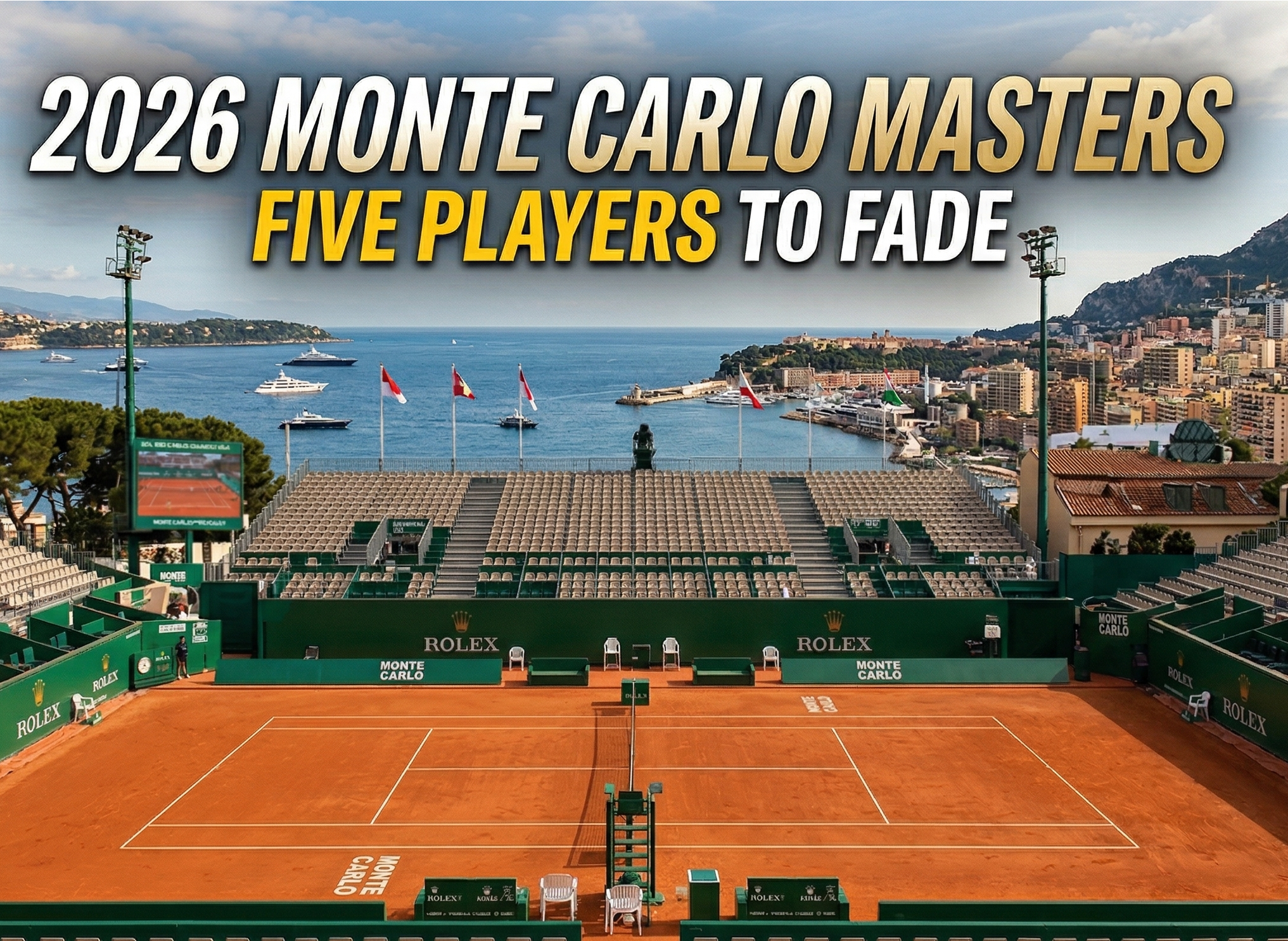
We’re only days away from the start of the 2026 Monte Carlo Masters.
This is the event that signals the start of the European Clay Court season, which means most of the players on this year’s entry list haven’t gotten their socks very dirty yet.
I’ve shared my top favorites and long shots to win the Monte Carlo Masters. We’ll wrap up our pre-tournament preparations with five players I’m fading next week.
Read on for my list of 2026 Monte Carlo Masters fades.
🇲🇨 MONTE CARLO MASTERS 2026: THE COMPLETE HUB
The brackets are set. From the official draw to Phil’s exclusive betting intelligence, get everything you need for the first clay Masters of the season.
Joao Fonseca
The talent is real. Big forehand. Clean ball striker. Plenty of upside.
But right now, Joao Fonseca hasn’t backed up the clay-court hype.
His clay results show it.
Over Fonseca’s recent stretch on clay, he’s playing .500 ball, and the losses tell you all you need to know.
He’s been beaten by players like Alejandro Tabilo, Jesper De Jong, Fabian Marozsan, and Jack Draper, players who stay solid, extend rallies, and make you hit extra balls.
That’s exactly what Monte Carlo demands.
Even when he wins, there are warning signs:
- He gets pulled into long matches instead of controlling them
- His rally tolerance drops against heavy topspin
- His sliding and recovery still break down under pressure
From a coaching standpoint, this is simple.
On faster courts, he can hit through people.
Here, the ball keeps coming back, and that’s been a huge problem for the young Brazilian.
He’ll have moments. Maybe even a good win, just not enough of them to win this event.
Alexei Popyrin
Big serve. Big power. Looks dangerous on paper.
But Alexei Popyrin’s recent results tell a different story.
He’s started this season just 3-9, and that matters coming into a tournament like Monte Carlo, where confidence and physical endurance are everything.
Now, look at his clay-court results.
There are some wins in there, but look closer at who they came against. When he steps up a level, the matches turn quickly:
- Lost to Tommy Paul at Roland Garros
- Lost to Daniil Medvedev in Rome
- Lost to Cam Norrie in Geneva
- Lost to Alejandro Davidovich Fokina here in Monte Carlo
From a coaching standpoint, his game is built for hard-court tennis.
Big serve, big forehand, finish points quickly.
Monte Carlo doesn’t allow that.
The 3-9 start isn’t just a number. It reflects a player who’s lost his confidence, and now misses shots that were once routine for him.
Popyrin might look like a value based on name and betting odds, but on this surface, and against players who can grind, his edge disappears fast.
Grigor Dimitrov
On paper, this looks like a great spot for him.
Grigor Dimitrov is a two-time semifinalist in Monte Carlo and owns a strong 27-13 career record at this event. That tells you he understands the surface and has had success here.
But his current form tells a different story.
Since Dimitrov’s pectoral injury at Wimbledon, when he was up two sets and a break against Sinner, he hasn’t been the same player.
- Just 2-6 this season
- 3-7 since the injury
That’s not a small dip. That’s a clear drop in level.
From a coaching standpoint, this is what stands out.
Dimitrov’s game relies heavily on timing, movement, and variety. When he’s right, he flows through points.
When he’s not, the timing gets disrupted and the errors start to creep in.
On clay, that becomes even more of a problem.
You have to build points over and over again. You can’t rush it. And if your confidence or physical level is even slightly off, long rallies expose you quickly.
Dimitrov’s past success here will keep his name popular.
But Monte Carlo doesn’t reward popularity or history. It rewards players who can grind right now.
And based on Dimitrov’s current form, that’s a big question mark.
Crush & Rush News: ATP & WTA Entry Lists
Stay ahead of the draw. Get the definitive look at the field before the first ball is struck.
Felix Auger-Aliassime
Elite athlete. Big serve. Explosive game.
But Monte Carlo slows everything down, and his poor clay court numbers back it up.
Over the past year, Felix Auger-Aliassime won just 37.5% of his clay matches. That’s not a small dip.
Now here’s where people get fooled.
He’s had some decent results in Madrid.
But Madrid is played at altitude. The ball moves faster, his serve has more pop, and points stay shorter.
That plays right into his strengths, but Monte Carlo plays the opposite.
Sea level. Heavy air. Slower court. Higher bounce.
Now his serve comes back. Now rallies stretch. Now he must build points and defend.
And when that happens:
- He’s still giving away 2 or more double faults per match
- His return games don’t apply steady pressure
- He struggles to stay patient in long rallies
From a coaching standpoint, it’s simple.
He’s playing hard court tennis on a clay court, and that doesn’t work in Monte Carlo.
He can get through a round or two on talent.
But asking him to string together wins here against players who are comfortable grinding is a big ask.
Tomas Machac
Solid all-around player. Moves well enough. Competes hard, and has some solid victories on this surface.
But clay courts ask for endurance, and that is something that Machac struggles with.
Over the last 52 weeks, he’s had four retirement losses. That’s not bad luck. That points to physical issues, especially in matches that get long and demanding.
Now bring that into Monte Carlo.
This is one of the most physical events on the calendar. Long rallies, heavy conditions, and matches that wear on your legs over time.
From a coaching standpoint, durability is everything here.
If you’re not fully built to handle repeated long matches, it shows up quickly.
You’re asking a player with recent physical concerns to survive multiple long clay matches against opponents who are comfortable grinding.
He can win a match.
But asking him to hold up physically over several rounds in these conditions is a big risk.
Coaching Bottom Line
Monte Carlo isn’t about who hits the biggest shot.
It’s about who can last.
Who can slide, recover, and stay focused when the rallies get long and the legs get heavy.
I’ve seen it for decades. Players look great early, then slowly fade as the match wears on.
These five have talent.
But on this surface, that’s not enough.


Phil Naessens is a tennis betting analyst and former tennis coach with decades of experience in player development and match analysis. He is the founder of Crush Rush News and host of the Crush & Rush Tennis Podcast, focusing on price-first betting strategy, market efficiency, and transparency in sports wagering.