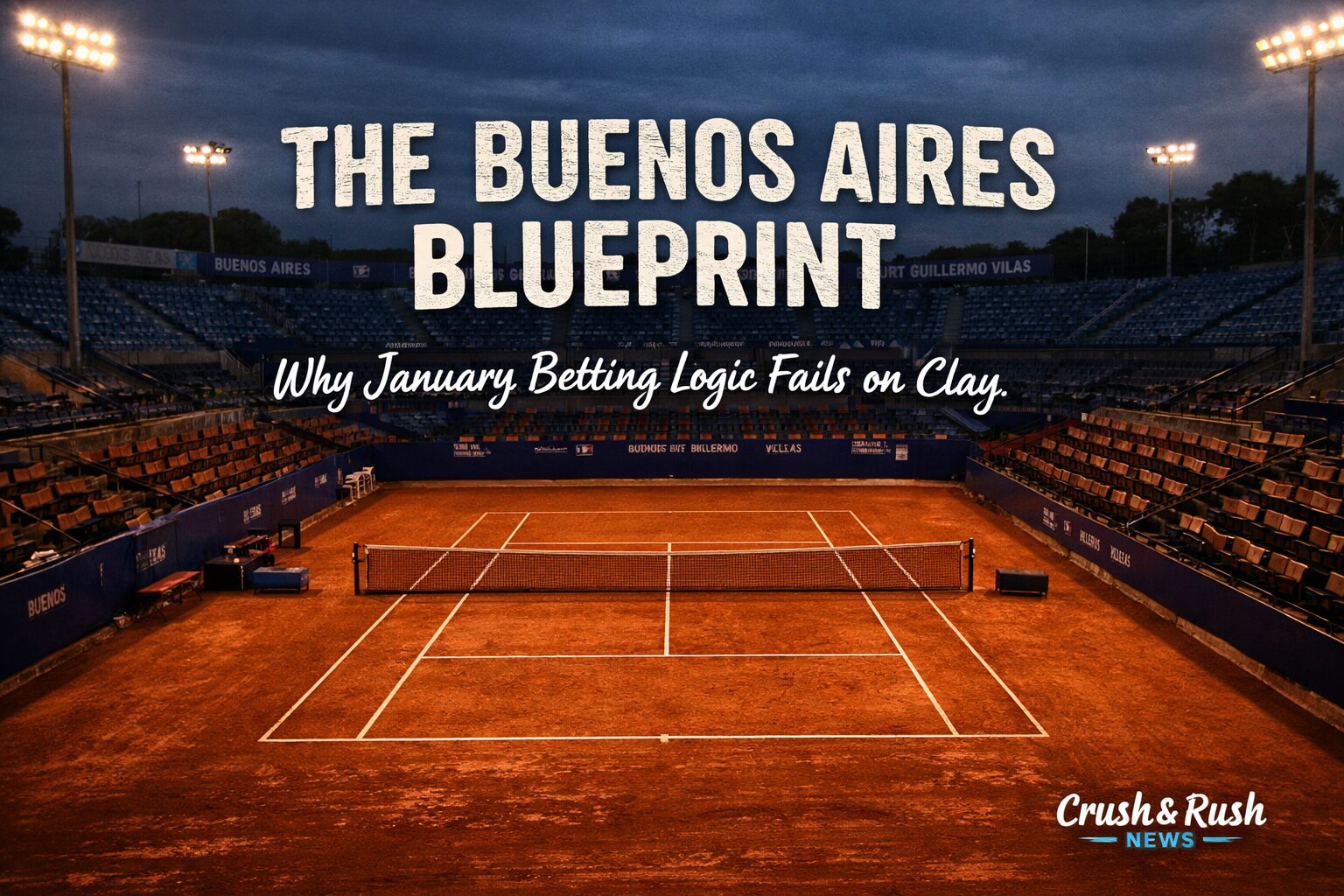
This Buenos Aires betting guide breaks down why tennis bets that worked in January stop working on Argentina’s clay courts.
The Golden Swing is where hard-court assumptions collide with heavy air and rallies that refuse to end.
In Buenos Aires, raw power is often a liability and speed is redefined.
If you are still betting based on Australian Open form, you are playing by a rulebook that no longer applies on Court Guillermo Vilas.
Read on for The Bettor Angle Buenos Aires betting guide.

The Three Red Flags (The Fades)
Stop backing these profiles early in the South American swing. They are not bad players. They are bad fits for this environment.
1. The Flat-Hitter Trap
The Logic
Clay grabs the ball and kills pace. Flat shots that skidded through Melbourne now sit up and invite counterattacks.
The Fade
Alexandre Müller (No. 7 seed). In the humid Buenos Aires night air, his shots lose penetration, allowing clay specialists to absorb pace and turn defense into offense.
2. The Serve-Dependent Pro
The Logic
On these slow courts, the serve is an entry point, not a weapon. Free points dry up and returners have time to reset every rally.
The Fade
Matteo Berrettini. Without cheap holds, he is dragged into 20-shot exchanges, a physical battle his movement and endurance rarely win on clay.
3. The Movement Skeptic
The Logic
Clay requires a natural slide. Step-and-plant movers arrive late and recover slowly.
The Fade
Daniel Altmaier (No. 5 seed). His powerful backhand requires perfect positioning. When forced to hit on the run without a natural slide, his error count spikes.
The Green Flags (The Targets)
Buenos Aires rewards profiles, not flash. Look for these traits to find value.
Heavy Topspin With Margin
Local favorites Francisco Cerúndolo (No. 1 seed) and Sebastián Báez (No. 4 seed) do not need clean winners. They win by forcing errors late through depth and heavy rotation.
Natural Recovery
Defending champion João Fonseca (No. 3 seed) showed last year that efficiency compounds. Players who slide naturally stay neutral in long exchanges while opponents bleed energy.
Crowd and Emotional Control
With three of the top four seeds being Argentine, Cerúndolo, Báez, and Darderi, the partisan atmosphere becomes a weapon. Locals know how to ride the wave. Visitors often rush points trying to quiet the stands.
The Reality Check: 23 Games
The average opening-round match in Buenos Aires produces 23 total games.
The Takeaway
A 22.5 or 23.5 game total is not high. It is the baseline for this surface.
The Rule
Do not blindly bet the Under because the names look lopsided. Only pull the trigger if you can clearly explain why a match will be shorter than that 23-game average. If you cannot, the best bet is no bet.
Final Thought
January rewards speed. Buenos Aires rewards survival.
If your bets feel uncomfortable, listen to the surface. It is telling you the rules have changed.
For Further Reading
- Sabalenka Leads Polymarket 2026 French Open Odds, But Clay Still Runs Through Świątek
- Men’s French Open 2026 Odds: Alcaraz Leads Sinner as Polymarket Shows Two-Man Race
- Indian Wells WTA Betting: Why -170 Favorites Burn Bettors
- Dallas Open ATP 500 Main Draw Predictions
- Rotterdam ATP 500 Draw Predictions: de Minaur Favored, Medvedev Tested, Bublik Lurks
- Swiatek Chases Fourth Doha Title in Five Years
- Rotterdam ATP 500 Betting Preview
- Doha WTA 1000 Betting Preview
- The Dallas ATP 500 Betting Preview
- The Buenos Aires Betting Blueprint: Why January Logic Fails on Argentina’s Clay
- The Anatomy of a Tout-How Betting “Transparency” Is Manufactured, Not Proven
- The Bettor Angle: 5 Bankroll Management Tips for Wagering on the Australian Open
- Bettor Angle: Why Most Bettors Lose Before the First Bet Is Placed
- The Bettor Angle: Why Sportsbooks Love 55% Bettors
- The Bettor Angle: Is It Ever Wise to Pay Sports Betting Touts for Picks?
- The Bettor Angle: The WTA Star Tax — Why Betting Big Favorites Is a Losing Strategy

Phil Naessens is a tennis betting analyst and former tennis coach with decades of experience in player development and match analysis. He is the founder of Crush Rush News and host of the Crush & Rush Tennis Podcast, focusing on price-first betting strategy, market efficiency, and transparency in sports wagering.