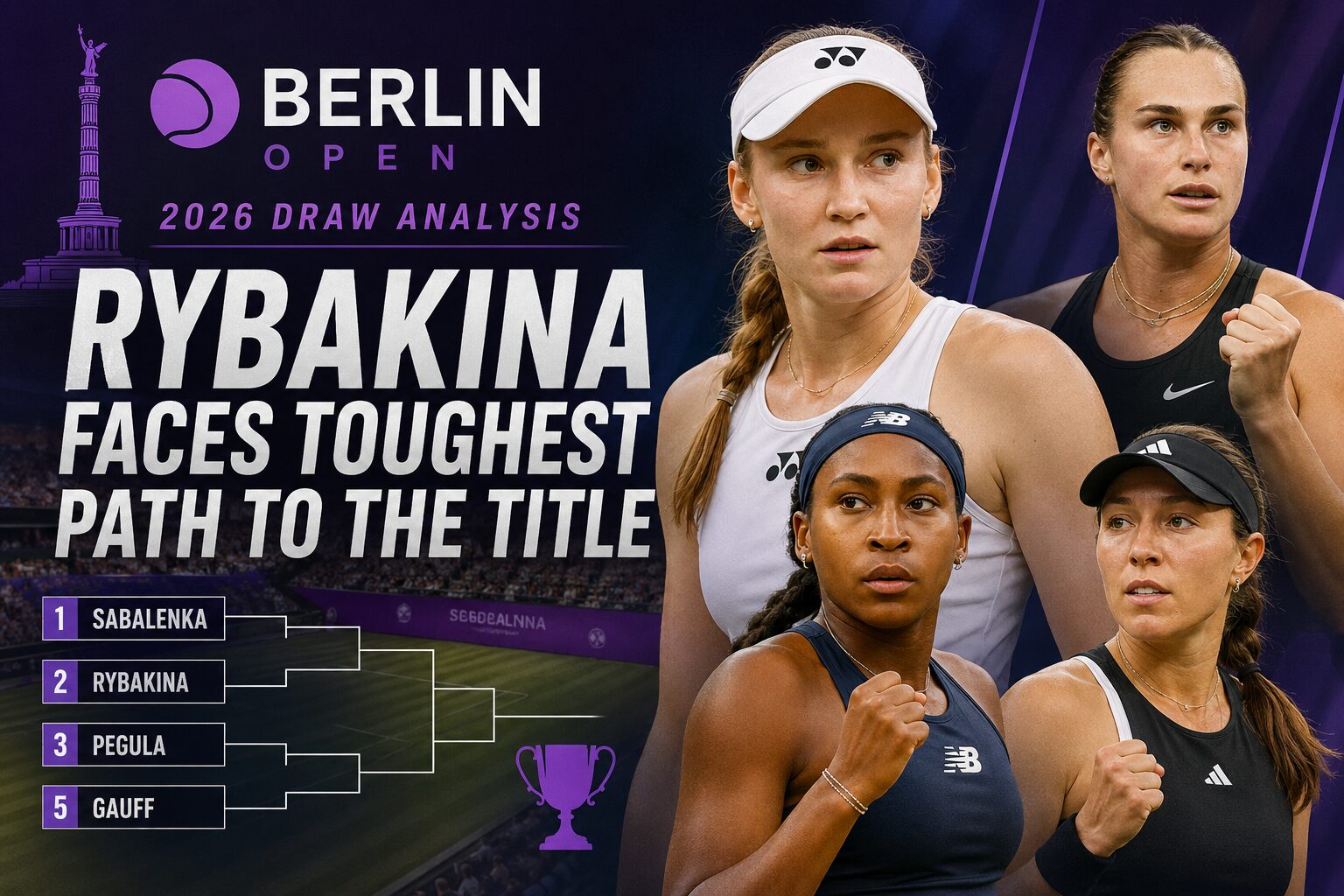
The 2026 Berlin Open draw is out, and if there was any hope of an easy week for the top seeds, it disappeared the moment the bracket was released.
This is one of the strongest grass-court fields of the season, featuring Grand Slam champions, Wimbledon finalists, rising stars, and several dangerous floaters capable of winning the title.
World No. 1 Aryna Sabalenka and No. 2 seed Elena Rybakina received first-round byes, but neither player was handed a straightforward path to the championship.
Read on for our 2026 Berlin Open Draw analysis, beginning Monday, June 15.
Stop chasing points. Start following the Gold Standard of performance metrics with Phil’s expert analysis and tactical data.
Sabalenka Faces Dangerous Grass-Court Threats Early
Top seed Aryna Sabalenka received a first-round bye, but her quarter is far from straightforward.
The world No. 1 could open against either Ekaterina Alexandrova or Anastasia Potapova, with Alexandrova representing the more dangerous grass-court challenge.
The Russian’s flat, aggressive game has historically translated well to faster surfaces, and she can take time away from opponents with her developing net play.
The bigger story, however, may be lurking in the bottom half of the quarter.
Liudmila Samsonova enters Berlin as one of the most dangerous grass-court players outside the top seeds. Her powerful serve and first-strike tennis make her a natural fit for the surface, and she has repeatedly produced some of her best results on grass.
French Open finalist Diana Shnaider also deserves serious attention. The 22-year-old owns a 14-8 career record on grass and captured the Bad Homburg title in 2024, defeating Paula Badosa, Emma Navarro, and Donna Vekic during that run.
She followed that breakthrough by reaching the Queen’s Club quarterfinals and recording another grass-court victory over Vekic.
Between Alexandrova’s aggressive shot-making, Shnaider’s proven grass-court success, and Samsonova’s ability to overpower opponents, Sabalenka must navigate one of the deepest sections of the draw to reach the final weekend.
Pegula Draws a Tricky Quarter
Third seed Jessica Pegula received a first-round bye, but her path through Berlin is anything but straightforward.
The American will open against either a qualifier or a lucky loser, a favorable start that should allow her time to settle into the tournament.
Madison Keys headlines the bottom half of the quarter and enters Berlin as one of the most dangerous players in the field. Her serve and first-strike power are particularly effective on grass, and if Keys finds her rhythm, she has the ability to hit through virtually any opponent.
Seventh seed Karolina Muchova rounds out the quarter. When healthy, few players possess a more complete grass-court skill set.
Pegula’s consistency and all-court game make her the favorite to emerge, but she will likely need to defeat multiple proven grass-court players to do it. This may not be the toughest quarter in the draw, but it is arguably one of the most balanced.
Gauff’s Quarter May Be More Dangerous Than It Appears
Fifth seed Coco Gauff received a first-round bye, but her section contains several players capable of making a deep run.
The biggest threat may be eighth seed Linda Noskova.
The Czech enters Berlin with some of the strongest recent grass-court results in the quarter, compiling an 8-3 record on the surface over the past 12 months.
Noskova’s powerful serve and aggressive baseline game have translated naturally to grass, making her a legitimate contender to emerge from the section.
Clara Tauson presents another dangerous obstacle. The Dane possesses the type of first-strike power that can be particularly effective on faster courts, while Paula Badosa remains a dangerous floater if healthy.
Gauff’s grass-court résumé is stronger than many realize. She owns a 24-12 career record on the surface, has reached the Berlin semifinals, and has twice advanced to the second week at Wimbledon.
However, she enters this year’s tournament seeking momentum after a difficult grass-court season that includes losses to Xin Yu Wang in Berlin and Dayana Yastremska at Wimbledon.
That contrast makes this one of the more intriguing quarters in the draw. Gauff has the strongest long-term résumé, but Noskova arrives with the better recent grass-court form.
If the seeds hold, a potential Gauff-Noskova quarterfinal could be one of the best matches of the tournament’s opening week.
Rybakina Faces the Deepest Quarter in Berlin
Second seed Elena Rybakina enters Berlin as one of the tournament favorites, but she may have received the most difficult quarter in the draw.
Sixth seed Elina Svitolina anchors the top half of the section and remains one of the most consistent performers on grass.
Anna Kalinskaya also lurks in the quarter, but the bottom half may be even more dangerous.
Donna Vekic arrives in Berlin carrying significant momentum after reaching the Queen’s Club final. Alexandra Eala adds another layer of difficulty, while home favorite Eva Lys rounds out the section and should benefit from strong local support.
Rybakina’s serve and power still make her the favorite to emerge, but this is a quarter loaded with experience, current form, and players capable of producing deep runs on grass.
If one section of the Berlin draw has the potential to produce the tournament’s highest-quality matches, this is it.
Key 2026 Berlin Open Opening Round Matches
- Ekaterina Alexandrova vs. Anastasia Potopova
- Elina Svitolina vs. Anna Kalinskaya
- Donna Vekic vs. Alexandra Eala

Phil Naessens is a tennis betting analyst and former tennis coach with decades of experience in player development and match analysis. He is the founder of Crush Rush News and host of the Crush & Rush Tennis Podcast, focusing on price-first betting strategy, market efficiency, and transparency in sports wagering.