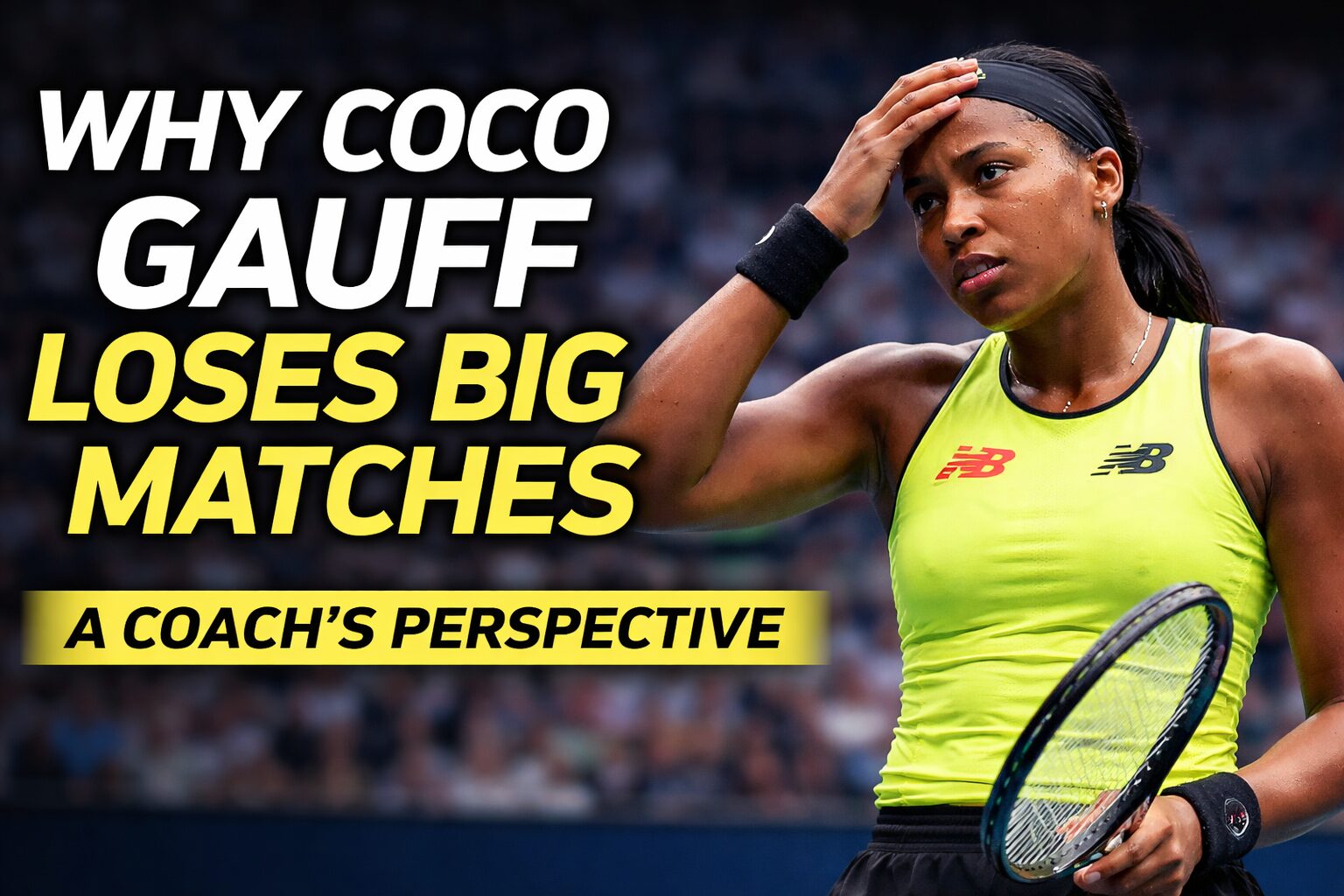
Coco Gauff doesn’t lose big matches because she lacks effort, belief, or toughness.
She loses them because there is a real difference between being a great athlete and being a fully built tennis player. At the highest level, that difference matters.
Coco is one of the best athletes in the sport. That athleticism carried her through juniors, through early pro success, and through most regular tour matches.
But in the biggest moments, when everyone on the other side of the net is just as strong and just as fast, athletic advantages disappear. What remains is structure, repeatability, and foundation.
We discussed this exact coaching topic on the Crush & Rush Tennis Podcast.
1. She Grew Up Winning With Athleticism, Not Structure
As a junior, Coco could waltz through opponents.
- She was faster.
- She was stronger.
- She was a better athlete than almost everyone she played.
Because of that, she did not need:
- a technically reliable second serve
- a forehand built to hold up under pressure
- repeatable offensive patterns
Athletic superiority covered the cracks. That is not unusual. Many elite players develop this way. But when athleticism stops separating you, the game has to stand on its own.

2. Why the Serve Goes First in Big Matches
In Coco’s biggest matches, the serve is usually the first thing to unravel.
As pressure rises:
- mechanics tighten
- rhythm disappears
- the second serve becomes something to survive, not attack
This is not about nerves. It is about the foundation.
If the serve was never the backbone of your game, it will not suddenly become one when the stakes are highest. Against elite players who step in and attack second serves, that weakness is quickly exposed.
3. Why the Forehand Can’t Carry Her Under Stress
At the top of the sport, opponents do not miss.
- Points do not end because someone ran fast.
- They end because someone hit through the court.
That is where Coco’s forehand becomes a problem in big matches.
The shot demands precise timing, clean spacing, and trust under pressure. When athleticism stops bailing her out, the forehand has to do more than it is currently built to do.
That is when it tightens, sprays, or becomes passive. Not because she is scared, but because the shot itself does not yet have enough built-in margin.
4. The Backhand Is Different, and That Explains a Lot
Coco’s backhand usually holds up. That is not an accident.
Two hands matter.
With two hands:
- the top hand can compensate for timing issues
- the swing stays compact
- strength masks small mechanical flaws
In simple terms, the backhand has structure.
The forehand and serve do not yet have that same safety net.
That contrast explains why one wing survives pressure while the others wobble.
5. Why Athleticism Stops Working Against the Elite
Against most players:
- Coco’s speed forces errors
- long rallies favor her
- points naturally reset
Against elite players:
- rallies do not break down
- defense becomes neutral
- nothing comes for free
When athletic advantages disappear, matches are decided by shot tolerance, margin control, and repeatable patterns, not speed. That is where the match usually turns.
6. The Body Language Is a Symptom, Not the Cause
When Coco struggles emotionally in big matches, it is easy to misdiagnose the problem.
- She does not lose because she shows emotion.
- She shows emotion because her game stops giving her answers.
When:
- the serve stops protecting her
- the forehand cannot finish points
- athleticism no longer separates
She is forced to problem solve without reliable tools. That is overwhelming for any young player. Tears are not weakness. They are frustration.
7. Perspective Matters, Her Rivals Were Not Complete Either
It is important to keep the competitive context honest.
Players like Aryna Sabalenka, Elena Rybakina, Jessica Pegula, and Amanda Anisimova were not complete players at Coco’s age either.
- They all had technical gaps.
- They all struggled in big moments.
Development at the elite level is not linear. Coco is not behind. She is right on schedule.
8. What Coco Does Not Need, Another Guru
The real risk for Coco is not talent. It is overcorrection.
- She does not need another guru.
- She does not need another philosophical reset.
- She does not need someone reinventing her every year.
She needs continuity. Someone who has known her a long time, understands her personality, trusts her athletic base, and calms things down instead of blowing them up.
You do not build foundations in chaos.
If I Were in Coco Gauff’s Box

For Further Reading
- Why Coco Gauff Loses Big Matches
- WTA Player Spotlight: Why Emma Raducanu Keeps Losing!
- Who Is Nikola Bartůňková? Australian Open 2026 Breakout Explained
- What Is Alycia Parks’ WTA Ceiling?
- Naomi Osaka’s Second Act: What Her Game Allows — and What It Doesn’t
- Mirra Andreeva Makes History with BNP Paribas Open Victory

Phil Naessens is a tennis betting analyst and former tennis coach with decades of experience in player development and match analysis. He is the founder of Crush Rush News and host of the Crush & Rush Tennis Podcast, focusing on price-first betting strategy, market efficiency, and transparency in sports wagering.