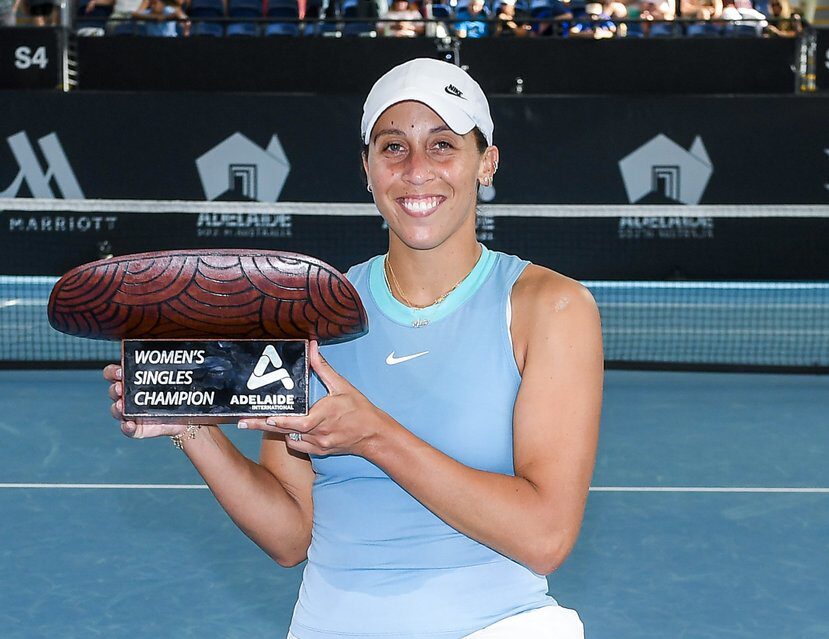
The Adelaide International betting analysis starts with understanding what this event actually delivers to the market, not with predicting a champion.
Early-season motivation gaps, uneven physical readiness, and rapid market overreactions create a week where prices matter far more than predictions, and where chasing a “winner” is usually the wrong approach.
When you strip Adelaide down to the betting data, a clear pattern emerges.
Early-round underdogs outperform expectations, favorites stabilize only as the week progresses, and the best returns come from understanding timing rather than talent.
This is not a tournament to crown a champion, it’s a market-reading exercise that rewards bettors who focus on price, not prestige.
Adelaide International — Men’s Futures Odds at FanDuel
| Player | Odds | Player | Odds | Player | Odds |
|---|---|---|---|---|---|
| Alejandro Davidovich Fokina | +500 | Tommy Paul | +600 | Tallon Griekspoor | +750 |
| Brandon Nakashima | +850 | Francisco Cerúndolo | +1000 | Tomas Macháč | +1200 |
| Stefanos Tsitsipas | +1200 | Sebastian Korda | +1400 | Ugo Humbert | +1400 |
| Valentin Vacherot | +1800 | Jaume Munar | +2700 | Reilly Opelka | +2700 |
| Alexei Popyrin | +2700 | Gabriel Diallo | +2700 | Miomir Kecmanović | +3500 |
| Marton Fucsovics | +4000 | Daniel Altmaier | +5000 | Ethan Quinn | +6500 |
| Damir Džumhur | +6500 | Thanasi Kokkinakis | +6500 | Terence Atmane | +6500 |
| Rinky Hijikata | +10000 | Tristan Schoolkate | +10000 | James Duckworth | +10000 |
How to Read the Adelaide Draw From a Betting Perspective
The draw matters in Adelaide, but not in the way most bettors think. This is not about identifying a tournament winner or projecting deep runs.
It is about identifying early-round pressure points, scheduling stress, and mismatches between price and intent.
Use the draw below as a reference tool, not a prediction map.
The value in Adelaide lies in understanding where uncertainty is highest early in the week, not in forecasting who will lift the trophy.
| Section | Matchups |
|---|---|
| Quarter 1 |
Alejandro Davidovich Fokina [1]: Bye Tristan Schoolkate [WC] vs Rinky Hijikata [WC] Thanasi Kokkinakis vs Sebastian Korda Miomir Kecmanovic vs Valentin Vacherot [5] |
| Quarter 2 |
Tallon Griekspoor [4]: Bye Ugo Humbert vs Terence Atmane Ethan Quinn vs Marton Fucsovics Damir Dzumhur vs Brandon Nakashima [6] |
| Quarter 3 |
Tomas Machac [8] vs James Duckworth [WC] Qualifier vs Qualifier Daniel Altmaier vs Jaume Munar Francisco Cerundolo [3]: Bye |
| Quarter 4 |
Stefanos Tsitsipas [7] vs Qualifier Qualifier vs Gabriel Diallo Reilly Opelka vs Alexei Popyrin Tommy Paul [2]: Bye |
Seeds 1 to 4 receive first round byes. Draw subject to change.
Adelaide International Men’s Champions
| Year | Champion | Runner Up | Final Score |
|---|---|---|---|
| 2025 | Felix Auger Aliassime | Sebastian Korda | 6-3, 3-6, 6-1 |
| 2024 | Jiri Lehecka | Jack Draper | 4-6, 6-4, 6-3 |
| 2023 | Kwon Soon Woo | Roberto Bautista Agut | 6-4, 3-6, 7-6 |
| 2022 | Gael Monfils | Karen Khachanov | 6-4, 6-4 |
| 2021 | Jannik Sinner | Stefano Travaglia | 7-6, 6-4 |
| 2020 | Andrey Rublev | Lloyd Harris | 6-3, 6-0 |
All past champs since the tournament returned to the calendar. Adelaide was not held in 2021 under its standard name. The Great Ocean Road Open served as the equivalent lead-in event that season.
Betting Results From Last Year’s Adelaide International
Before getting into match-by-match angles, it’s worth grounding expectations in what the Adelaide market actually delivered last season.
The 2025 edition reinforced a familiar theme for early-January ATP events: pricing errors showed up early, not late, and bettors who chased favorites indiscriminately paid for it.
Rather than pointing to individual results, the more useful lens is how odds behaved by round, and where value consistently appeared.
Biggest Upsets by Closing Odds (2025)
Last year’s Adelaide International betting analysis shows multiple underdog wins priced well beyond what most bettors would consider “live” numbers.
Several underdogs closed north of +200, with one opening-round result clearing +350, underscoring how fragile early pricing can be when motivation and readiness vary widely.
The takeaway isn’t that Adelaide is “upset-heavy”, it’s that books lean too heavily on name recognition early in the week, before match fitness and motivations become clearer.
Five Biggest Upsets at the 2025 Adelaide International
| Round | Winner | Loser | Closing Odds (Winner) | Closing Odds (Loser) |
|---|---|---|---|---|
| 1st Round | Maxime Guinard | Roman Safiullin | +377 | -556 |
| 2nd Round | Rinky Hijikata | Brandon Nakashima | +199 | -263 |
| 2nd Round | Marcos Giron | Denis Shapovalov | +165 | -213 |
| 1st Round | Rinky Hijikata | David Goffin | +125 | -159 |
| Semifinal | Felix Auger-Aliassime | Tommy Paul | +120 | -152 |
Final Betting Takeaway
Adelaide is not a tournament to solve. It is a tournament to observe.
Last year’s betting data makes that clear.
Early rounds carried the most uncertainty, underdogs outperformed pricing expectations, and the market only stabilized once intent and fitness revealed themselves.
Those patterns are not unique to one edition. They are structural to early January ATP 250 events.
For bettors, the Adelaide International betting analysis is simple. Adelaide rewards patience, selectivity, and restraint. The edge is not in predicting a champion or forcing action across the board.
It is in recognizing when prices fail to reflect uncertainty, and knowing when to stay out entirely.
The value from Adelaide often shows up later, in how this week informs Australian Open betting decisions.
Adelaide is a data-gathering week. The betting mistakes stem from treating it like anything more than it is.

Phil Naessens is a former tennis academy owner and longtime resident professional who has coached and evaluated players across the United States and Europe. He has worked in tennis hubs including Las Vegas, Mykonos, Dubai, and Corfu, bringing decades of first-hand experience in player development, match dynamics, and competitive readiness. His analysis focuses on on-court mechanics, physical signals, and betting market inefficiencies, with an emphasis on process and responsible wagering rather than hype or prediction.