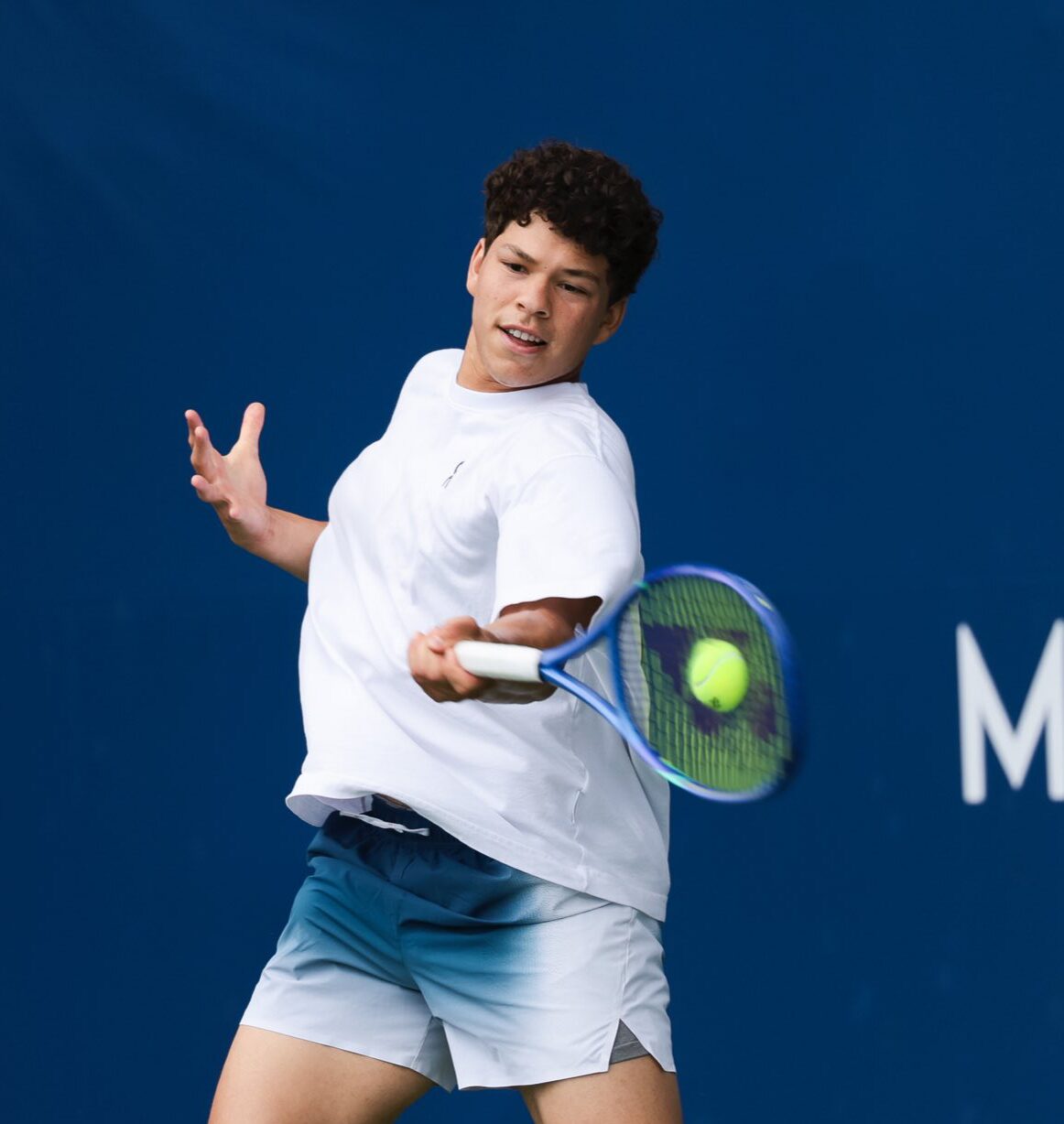
What Auckland Means to Ben Shelton isn’t about wins or trophies….it’s about answers.
A week before the Australian Open, the ASB Classic will tell us how fit Shelton really is, how freely he’s willing to swing, and whether his game is ready to hold up under Grand Slam pressure.
Shelton’s uneven finish to the 2025 season didn’t come out of nowhere. It dates back to the US Open, where he injured his shoulder mid-match and had to retire in the opening round against Adrian Mannarino.
He returned nearly one month later, competed hard, and stayed in the matches… but he never quite looked free again.
The serve still flashed.
The athleticism never disappeared.
But his authority, especially on return, quietly faded.
What changed last summer
No one should confuse Shelton with a natural returner. He’s not built that way, and he doesn’t need to be.
What changed last summer wasn’t dominance….it was competence.
Shelton began making enough returns to stay engaged in games. He wasn’t breaking often, but he was extending games, forcing extra balls, and keeping pressure on holds that used to come too easily.
That shift mattered because it took pressure off his rocket serve.
When the return held its own, Shelton no longer had to serve perfectly just to stay level. Tie-breaks calmed down.
Missed first serves didn’t feel fatal. His game breathed.
That balance showed up clearly during his best stretch of the year on the American cement.
What that stretch actually was
Shelton’s North American summer run was when the return game quietly did its job and freed everything else.
It started in Washington, carried through Toronto, and continued in Cincinnati…..a stretch where Shelton wasn’t breaking serve at will, but was consistently making opponents uncomfortable.
Return games lasted longer. Holds weren’t automatic. And the pressure stopped flowing in only one direction.
During that run, Shelton beat quality hard-court players, handled tight moments, and played his best tennis of the season without needing the serve to bail him out every time.
The return wasn’t a weapon; it was functional. And that functionality took pressure off his rocket serve while placing some of it back where it belongs: on his opponents’ own service games.
That’s the version of Shelton that the shoulder injury interrupted at the US Open.
And that’s the version Auckland is designed to test.
Where it unraveled
The shoulder injury at the US Open didn’t erase that progress — it interrupted it.
Against predictable servers like Andrey Rublev, Shelton could still step in and compete. But against elite servers who disguise direction and force late decisions… players like Jannik Sinner and Alexander Zverev… the return game pulled back.
Not dramatically. Quietly.
Returns were blocked instead of driven. He leaned on the slice backhand rather than trusting himself to finish points with a backhand he didn’t feel fully confident in.
Pressure stayed on the serve. Tie-breaks became reactive instead of assertive.
That’s what injury management looks like at this level: not collapse, just constraint.
Why Auckland matters
That’s why the ASB Classic matters more than it appears on the surface.
Auckland isn’t about momentum or trophies. It’s about answers.
It’s the last stop before the Australian Open, where Shelton can test his game without the physical and mental demands of five-set tennis. The courts are quick, the points are honest, and hesitation gets exposed fast.
If Shelton is fully fit, we’ll see it immediately:
- he’ll commit on returns, even when he misses
- return games will feel competitive again
- the serve won’t have to carry the entire match
If he isn’t, he’ll still look solid — but the balance won’t quite flip.
Wins won’t be the story here.
His willingness to step in and let his forehand rip on the return is the real story.
The bigger picture
Shelton doesn’t need Auckland to prove he belongs among the elite. He already does.
What Auckland offers is clarity: how fit he really is, how much the shoulder still influences decision-making, and whether his improved return game is ready to relieve pressure on the serve again.
We’ll discover in Auckland just how ready Shelton is….and whether an Australian Open breakthrough is a realistic conversation or one best saved for later in the season.
Either way, speculation ends in Auckland.
ASB Classic Auckland ATP 2026 — Men’s Entry List
| Player | Ranking |
|---|---|
| Ben Shelton | 9 |
| Casper Ruud | 12 |
| Jakub Mensik | 19 |
| Luciano Darderi | 26 |
| Cameron Norrie | 27 |
| Alex Michelsen | 38 |
| Lorenzo Sonego | 39 |
| Alexandre Muller | 42 |
| Sebastian Baez | 45 |
| Nuno Borges | 47 |
| Camilo Ugo Carabelli | 49 |
| Fabian Marozsan | 51 |
| Jenson Brooksby | 53 |
| Valentin Royer | 58 |
| Giovanni Mpetshi Perricard | 59 |
| Tomas Martin Etcheverry | 60 |
| Francisco Comesana | 61 |
| Aleksandar Kovacevic | 62 |
| Gael Monfils (WC) | — |
| Stan Wawrinka (WC) | — |
Tournament Information
- Dates: January 12–17, 2026
- Location: Auckland, New Zealand
- Surface: Outdoor hard court
- Draw: Expected January 10–11
- Schedule: Released January 12
For Further Reading
Australian Open 2026 — Contenders, Entry Lists, Odds & Analysis
The Bettor Angle — Method, Mindset & Value
Taylor Fritz — What His Game Allows and What It Doesn’t
Can Ben Shelton Win a Grand Slam in 2026?
Which Men Can Actually Win the 2026 Australian Open — Breaking Down the Real Contenders