The Power of Presence — and the Search for Surface Versatility
Naomi Osaka’s Second-Act Ceiling
What is Naomi Osaka’s Grand Slam ceiling — now?
Naomi Osaka has already achieved what most players only dream of: four Grand Slam titles and the World No. 1 ranking, anchored by arguably the most clinical hard-court game of her generation.
The question surrounding Osaka in 2026 is no longer whether she can win at the highest level.
It is whether she can evolve beyond the “hard-court specialist” label and develop the tactical balance required to dominate a WTA landscape now defined by the relentless consistency of Iga Świątek and the raw power of Aryna Sabalenka.
To evaluate that honestly, we begin with the unconventional path that brought her here.
The “Williams Blueprint” (Early Career Path)
Unlike most elite players of her generation, Osaka bypassed the traditional ITF junior circuit entirely, following a development model inspired by Venus Williams and Serena Williams.
- Pro debut at 14 (2011): Played her first professional qualifying match on her 14th birthday
- Breakthrough moment (2014): At age 16 and ranked No. 406, defeated world No. 19 Samantha Stosur in her WTA main-draw debut at Stanford
- WTA Newcomer of the Year (2016): Cracked the Top 50 after reaching the Tokyo final and the Australian Open third round
- The 2018 launchpad: Indian Wells title run featuring wins over Maria Sharapova and Simona Halep, followed by her historic US Open victory over Serena Williams
Osaka did not rise gradually. She arrived fully formed.
Pro Career Snapshot
- Career-high ranking: No. 1
- Grand Slam titles: 4 (2× US Open, 2× Australian Open)
- WTA singles titles: 8
- Grand Slam final record: 4–0
- Known strengths: Serve, explosive first-strike power, elite big-moment composure
Her 2025 season marked a genuine return to form following maternity leave, highlighted by a Montreal final and a US Open semifinal run….evidence that the core of her game remains intact.
Career Match Record by Surface
(Through start of 2026 season)
| Surface | Record | Win % | Titles |
|---|---|---|---|
| Hard | 226–114 | 66.4% | 7 |
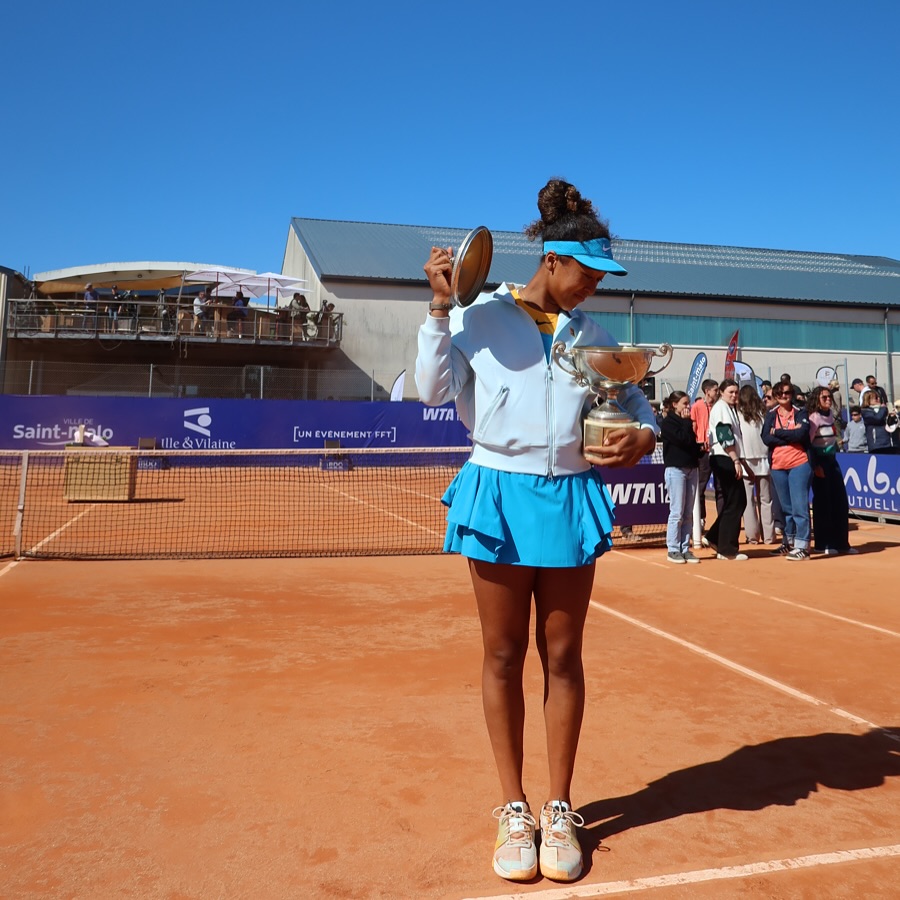
| Clay | 47-36 | 56.6% | 1 (WTA 125) |
| Grass | 24-20 | 53.6% | 0 |
| Overall | 301-171 | 63.7% | 8 |
These numbers define Osaka with clarity.
Hard courts are her kingdom. On clay and grass, the drop-off remains pronounced…and it is the single biggest barrier to year-round dominance.
What Osaka Does Well
Naomi Osaka plays heavy tennis.
She owns:
- An elite serve that is a point-ending weapon and a pressure-release valve
- Clean ball-striking with short, efficient mechanics that steal time
- Big-match temperament — her 4–0 Slam final record is not accidental
Under new coach Tomasz Wiktorowski, Osaka has tried to shy away a bit from her big-babe tennis days. She’s been more deliberate in point construction, and seemingly light-years removed from the pure all-or-nothing aggression that once defined her game.
When Osaka controls first contact and dictates off the forehand, she still can roll anyone quickly….even against the very best.
Where Osaka Struggles
The limitations are structural, not psychological.
- Surface adaptation: Sliding, recovery steps, and balance on clay and grass remain inconsistent
- Plan-B scarcity: Against elite defenders who absorb pace and extend rallies, Osaka still lacks variety (slice, drop shot, height changes) and goes big or goes home.
- Consistency vs. peaks: Her form spikes at the majors but dips in smaller events, skewing rankings and leading oddsmakers to routinely overprice the Japanese star.
When her timing is slightly off, her high-risk baseline game produces errors faster than she can compensate.
Record vs. Elite Competition
| Opponent | H2H | Context |
|---|---|---|
| Iga Świątek | 1–2 | Pushed Swiatek deep at 2024 Roland Garros |
| Aryna Sabalenka | 1–1 | Pure power vs power |
| Coco Gauff | 2–2 | Movement vs first strike |
| Elena Rybakina | 0–1 | Clash of elite serves |
“She was a different player last year with the coaching change — clarity, motivation, and a better understanding of court geometry.”
— Rick Macci
Context matters here. Osaka still beats elite players, but only when conditions and rhythm align.
The Slam Question
This brings us to the central evaluation.
Naomi Osaka is already a hard-court legend. That debate is over.
But Grand Slams are not won by power alone, especially on slow courts, deep into week two, against players who refuse to miss.
If her performances at the 2024 French Open and her late-2025 surge are any indication, the “hard-court specialist” is evolving.
The question is whether that evolution will culminate in a fifth major….and whether it will finally come on something other than blue cement.

Further Reading
- Australian Open 2026 Contenders, Entry Lists & Odds
A comprehensive preview of title favorites and draw dynamics heading into the first major of the year. - WTA Tour Tennis Betting Stats
Deep data on form, surfaces, and statistical patterns across the women’s tour — essential context for evaluating surface versatility. - The Bettor Angle
Strategy-focused breakdowns that blend analytics with tactical insight — great primer for understanding performance risk/reward. - Taylor Fritz: What His Game Allows — and What It Doesn’t
A structural comparison of how surface adaptability and shot selection define elite career ceilings. - Can Ben Shelton Win a Grand Slam in 2026?
Another second-act narrative with parallels to Osaka’s power-versus-structure story arc.