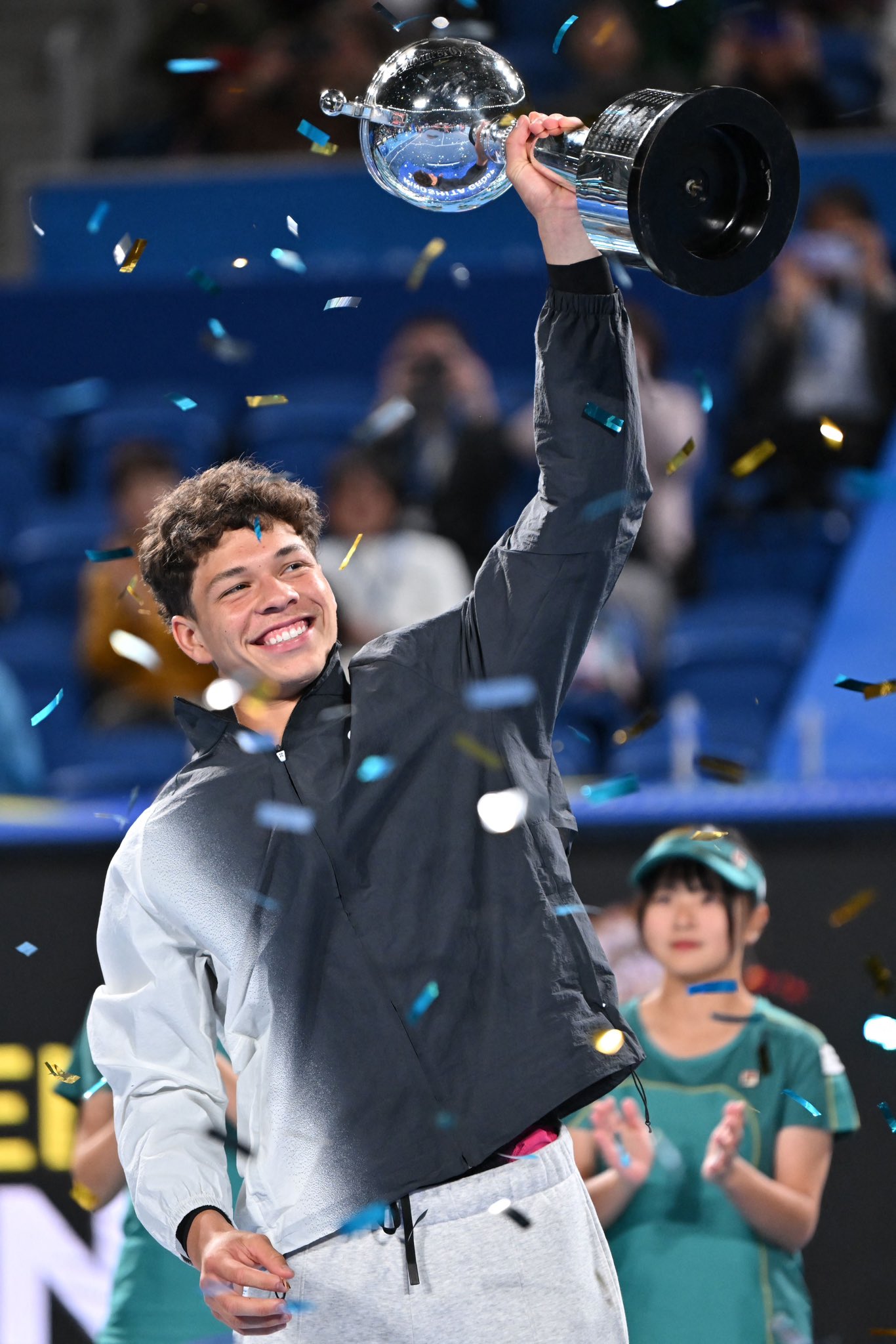
What is Taylor Fritz’s Grand Slam ceiling?
He has built a long, productive career at the highest level of men’s tennis, anchored by a powerful serve, a heavy forehand, and a professional approach that allows him to win consistently across surfaces.
The question surrounding Fritz has never been whether he belongs near the top of the game. It’s whether his profile contains the extra gear required to win a Grand Slam….a gear that only reveals itself against the best in the world when it matters most.
To answer that honestly, we start with what his career has actually produced.
Key Junior Achievements
ITF World No. 1 Junior (2015)
Finished the season ranked No. 1 in the ITF junior rankings.
Grand Slam Junior Results (2015):
- US Open Boys’ Singles Champion
- French Open Boys’ Singles Finalist
- Quarter Finals or better at all four junior Grand Slams
ITF Junior World Champion (2015)
Named the ITF Junior World Champion, awarded to the most accomplished junior player of the season.
Historic American Milestone
Became the first American ITF Junior World Champion since Donald Young (2005) and Andy Roddick (2000).
Junior Performance Profile
Compiled a dominant junior win rate, particularly on hard courts, including a 91% winning percentage during one extended stretch — a clear indicator of his surface strengths translating early.
Pro Career Snapshot
- Career-high ranking: No. 5
- ATP singles titles: 17
- Masters 1000 titles: 1 (Indian Wells, 2022)
- Grand Slam best result: 2024 US Open Final
- Known strengths: Serve, forehand, first-strike baseline tennis
Fritz has been a model of durability and consistency. But consistency and separation from the ATP Tour elite are not the same thing.
Career Match Record by Surface
Career Performance by Surface (Singles)
| Surface | Career Record | Win % | Titles |
|---|---|---|---|
| Hard | 328–182 | 64.3% | 12 |
| Clay | 63–50 | 55.8% | 1 |
| Grass | 55–30 | 64.7% | 5 |
| Overall | 446–262 | 63.0% | 18 |
These numbers define Fritz clearly.
Hard courts are his foundation, Grass amplifies his strengths, while clay courts remain his Achilles Heel.
Nothing here is surprising — but nothing here suggests domination either.
Career Titles and Finals Context
Fritz’s career finals record stands at 17–12, with the majority of his titles coming at the ATP 250 and ATP 500 level.
His lone Masters 1000 title (Indian Wells) stands out as an exception rather than a trend…a peak moment rather than a repeated outcome.
Titles matter because they reveal where a player finishes, not just how often he competes well.
What Fritz Does Well
Taylor Fritz is a classic first-strike player.
He owns:
- a huge serve that creates free points
- a powerful forehand capable of finishing rallies
- an aggressive baseline game that rewards proactive tennis
On faster courts, these tools allow him to dictate play, shorten points, and overwhelm large portions of the tour.
When Fritz is landing his first serve and controlling forehand exchanges, he can beat almost anyone on a given day.
Where Fritz Struggles
At the very top of the sport, however, margins shrink.
Fritz’s court speed and lateral movement are solid but not exceptional, which limits him when rallies extend or when elite opponents consistently pull him out of his comfort zone, force him to hit backhands on the run, and catch him flat-footed with their dropper.
There is also an element of tactical predictability in his patterns. His structure is sound, but against top-tier defenders and returners, that structure becomes easier to read.
When the Americans’ first strike is neutralized, Fritz is often forced into longer exchanges where his rally tolerance isn’t good enough to beat Jannik Sinner, Carlos Alcaraz, and Novak Djokovic.
This is not a question of effort or belief. It’s a question of having the big tools at the latter stages of Grand Slams, and he hasn’t demonstrated much of that, especially against the strongest defenders on tour with bigger and more consistent weapons under pressure.
Record vs Top-10 Competition
Career Record vs Top-10 Opponents
- 33–49 (40.2% win rate)
This is a meaningful sample size.
It shows that Fritz belongs at this level, but also that he rarely separates consistently against the very best.
Grand Slam champions typically defeat multiple Top-10 players in one event. Fritz’s 40% career win rate against the ATP Tour elite is terrific, but he needs to beat Alcaraz, Sinner and Djokovic, and he can’t seem to manage that.
Head-to-Head vs Elite Peers
Career Head-to-Head (All Surfaces)
| Opponent | H2H Record |
|---|---|
| Jannik Sinner | 1–4 |
| Carlos Alcaraz | 1–5 |
| Novak Djokovic | 0–11 |
| Alexander Zverev | 9–5 |
| Felix Auger-Aliassime | 3–1 |
Context matters here.
Fritz’s win over Jannik Sinner came early in Sinner’s career, before Sinner became one of the tour’s most complete players, while his victory over Carlos Alcaraz, however, came at the meaningless Laver Cup exhibition.
Against true separators….players who defend, adapt, and apply sustained tactical pressure…Fritz has consistently struggled to win big points in the later stages of the Slams.
Against peers with similar power profiles, he has been far more successful.
The Slam Question
This brings us to the central question — not as a criticism, but as an evaluation.
Taylor Fritz has built an excellent career. He wins often. He competes honestly. He raises the bar for American men’s tennis and is a credit to his parents and society, both on and off the court.
But Grand Slams are not won by reliability alone.
They are decided by separation under pressure, by adaptability, and the ability to win when Plan A is taken away.

For Further Reading
- Can Ben Shelton Win a Grand Slam in 2026?
A contrasting profile of power, volatility, and upside among American men. - ATP Rising Stars and Breakthrough Players for 2026
Which young players are positioned to challenge the sport’s established order. - Americans Lead a Youth Surge as the 2026 Australian Open Entry List Drops
How Fritz fits within the current American landscape. - Australian Open Hub
Draws, previews, player spotlights, and betting insights for the season’s first major. - ATP Tour Stats Hub
Surface records, head-to-heads, and performance data used throughout this analysis.